SteamIQ
SteamIQSteam Trap Intelligence

Still Doing Steam Trap Surveys?

See what 90 days of continuous intelligence looks like.

Scroll to read a sample report
SteamIQ
Northmark Health
Fleet Performance Report
Apr 15, 2026 – Jul 13, 2026  •  10 devices  •  Recurring report
Executive Summary
Your fleet story in 30 seconds
Not a data dump — a financial narrative. Where the money is leaking, which sites are driving it, and what to do first. Written from 90 days of continuous data, not a single-afternoon walk-through.

Executive Summary

Your fleet is operationally sound — 60% of traps are healthy and all 10 devices are reporting telemetry — but it is carrying a concentrated financial problem. Four traps are in active failure states, and the period recorded $103,318 in steam loss across the fleet. The clearest single opportunity is a small set of failed-open traps: three devices carry sub-week repair payback periods, and the forward-look model estimates roughly $268,412 in annualized loss becomes addressable the moment they're serviced. This is the first monitoring period for the fleet, so these figures establish your baseline — the scoreboard you'll measure progress against.

Two things deserve immediate attention. First, the failed-open traps at Northmark Children's Hospital and Cancer Institute are actively wasting steam every hour they run, and Massachusetts gas pricing — currently about 5× the national average — magnifies every therm lost. Second, SteamIQ's analytics engine detected a water hammer event in Sub-Basement Room 4 (Northmark Women's Hospital) with a noted history of recurrence in that zone; water hammer is a safety and equipment-integrity risk that warrants a physical inspection. Below we lay out the health picture, the money story, what our intelligence layer caught, and a prioritized action plan your team can hand straight to a technician.
Critical Finding — Safety
A water hammer event (severity 117.0, warning level) was detected on 2026-05-25 in Sub-Basement Room 4 (SteamIQ Demo-14, Northmark Women's Hospital), a zone with a noted history of recurring events. Water hammer can crack trap bodies and distort internals — a physical inspection of the piping and condensate return lines in this zone is the top safety priority this period.
Fleet Health
Every trap, every day
Health score, failure states, and where the trend is heading — updated continuously, not a snapshot from the day someone walked the plant. Six of ten healthy here; the four that aren’t carry the whole story.

Fleet Health Overview

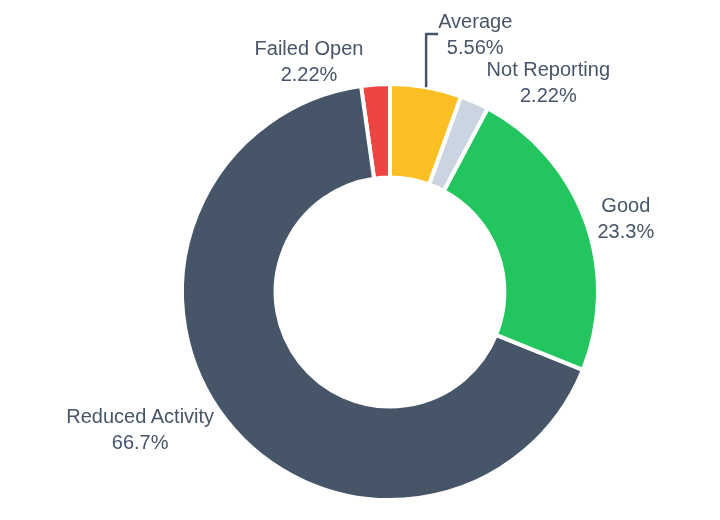
The fleet health score stands at 92.8, up 0.9 points from the prior period's 91.9. Six of ten traps are healthy and every device is reporting. That said, the four failures carry the story: three are failed-open (actively wasting steam) and one is failed-closed (blocking condensate return). The three reduced-activity traps are idle or lightly loaded — a normal operating state, not a problem to fix.

92.8
Fleet Health Score (+0.9)
6 / 10
Healthy Devices (60%)
4 / 10
Failed Devices (40%)
100%
Reporting (0 offline)

State Distribution

Fleet State Chart
State Devices Category
Good3Healthy
Reduced activity3Healthy (idle/low load)
Failed open3Failed
Failed closed1Failed

Health Trajectory

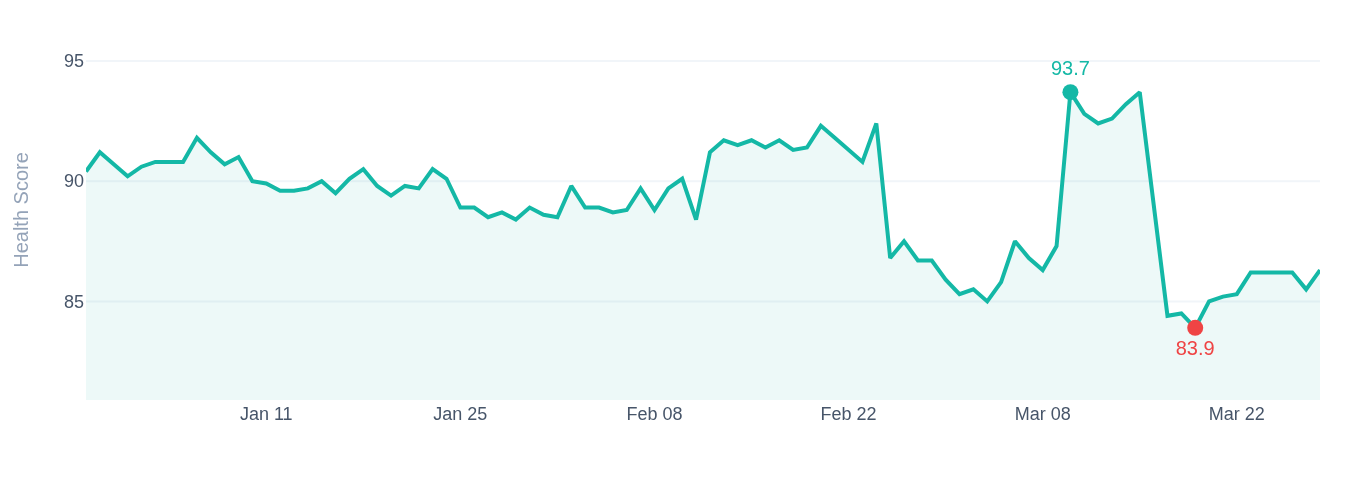
The health trend was volatile but showed no sustained deterioration. After erratic early swings, the fleet stabilized in the 88–92 range through late June, climbed to near-perfect health (99.5–100.0) for seven days in early July, then settled to the current 92.8. That recent step-down aligns with the formal detection of the four failures on 2026-07-12 — in other words, the movement reflects the system updating its state classifications as failures were confirmed, not a sudden new round of equipment breakdowns.

Health Trajectory Chart
Financial Impact
Every loss in dollars, not colors
Monthly trend, per-site concentration, and the one line where attention pays back fastest. A survey hands you “failed.” This hands your CFO “$103,318 this period, nearly two-thirds of it at a single facility.”

Financial Impact

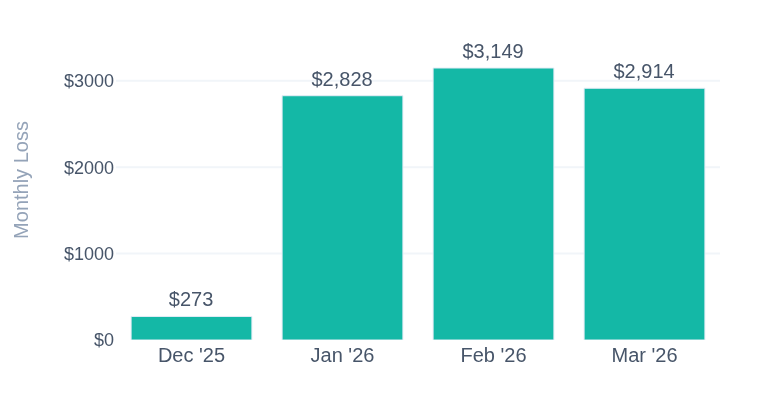
Total steam loss for the period was $103,318 across 10 devices, averaging $10,332 per device. On a full-month basis, losses rose from $20,290 in April to $35,675 in May (+75.8%), then held roughly steady at $34,532 in June (−3.2%). July is only 13 of 31 days elapsed (41.9% complete) at $12,821, so it is shown for reference only and should not be read as a downward trend.

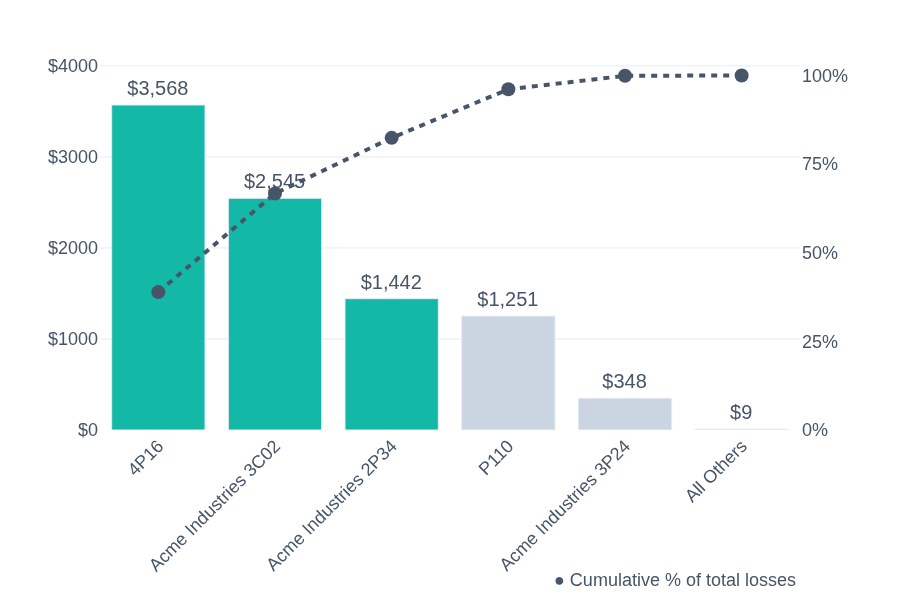
The loss is heavily concentrated. Northmark Medical Center holds 5 devices — 50% of the fleet — but accounts for $66,012 in period loss at 1.3× the fleet average per device. Northmark Children's Hospital is second with $30,946 (0.7× fleet average) across 4 devices. This concentration is the primary financial lever: the Medical Center line is where sustained attention pays back fastest.

Monthly Trend

Monthly Losses Chart
Month Loss Change
April 2026$20,290
May 2026$35,675+75.8%
June 2026$34,532−3.2%
July 2026 (13 of 31 days)$12,821partial

Asset Concentration

Asset Concentration Chart
Top 5 Device Offenders
Device Asset State Daily Loss Period Loss
Demo-12Children's HospitalFailed open$236$29,441
Demo-10Children's HospitalFailed open$342$1,503
Demo-15Cancer InstituteFailed open$157$435
Three failed-open devices account for the bulk of addressable loss. Demo-10 carries the highest daily loss but was moved onto an already-failing trap only 3 days ago, so its period figure is still small.
Energy Cost Context
Your gas price, your region
Every loss is priced at your state’s real natural-gas rate, pulled from federal EIA data — not a textbook average. Here that’s Massachusetts at roughly 5× the national price, which is what turns a leak into real money.

Energy Cost Context

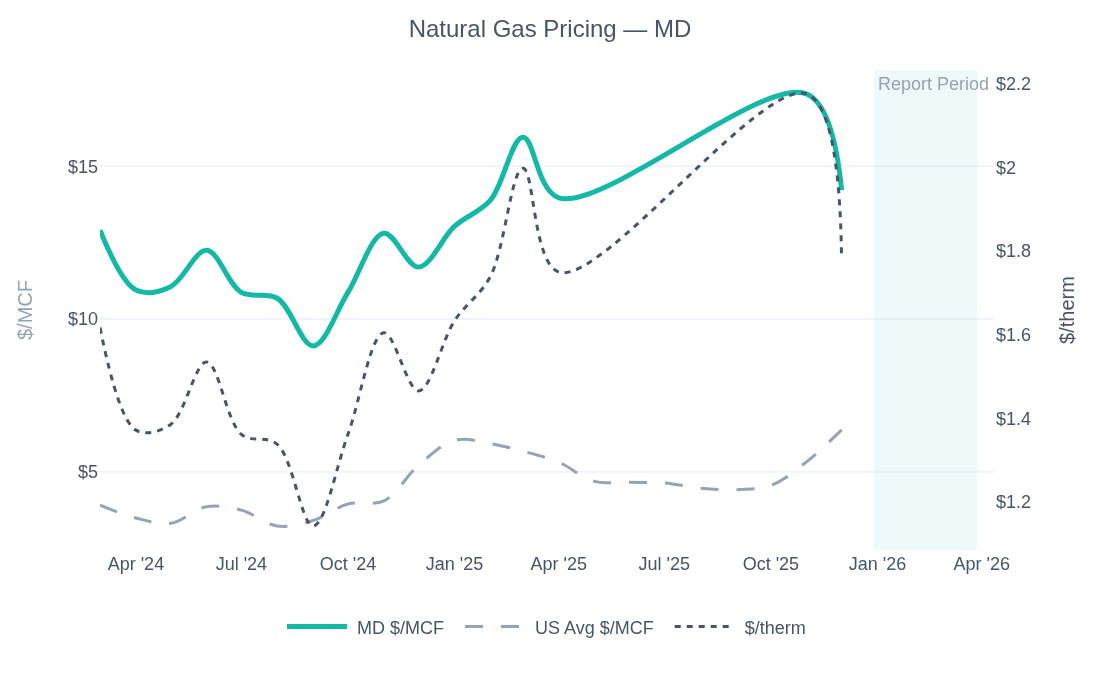
Massachusetts Industrial Gas — Current Pricing (April 2026)
$24.38/MCF  •  $3.05/therm  —  roughly 5× the national average. Every therm of wasted steam here costs multiples of what it would in most regions.
Gas Pricing Chart
Month $/MCF $/Therm Dir.
2025-05$14.83$1.86
2025-06$11.89$1.49
2025-07$12.20$1.53
2025-08$11.40$1.43
2025-09$11.31$1.42
2025-10$9.90$1.24
2025-11$13.35$1.67
2025-12$18.47$2.31
2026-01$17.98$2.25
2026-02$18.82$2.36
2026-03$19.97$2.50
2026-04$24.38$3.05

Massachusetts industrial gas follows a pronounced seasonal cycle. Over the historical profile, pricing peaks in April and troughs in October — a swing of about 126% between the high and low points. The current April reading of $23.49/MMBtu sits at the very top of the 24-month range and is up 42.9% year over year, so the fleet is being priced at its most expensive point in the annual cycle right now.

That pricing is what turns steam loss into real money. Your currently failed traps are losing an estimated 240.8 therms/day. Based on the historical monthly pricing pattern for the next six months, leaving these traps unrepaired would cost an estimated $70,350 — and note that the heaviest months in that projection fall in the November–January winter peak, where each therm gets more expensive again. Acting before that window is the economically rational move.

Pricing data is sourced from EIA.gov industrial rates. The most recent available data month is April 2026; because EIA publishes with roughly a 90-day lag, the latest reporting weeks use the most recent available pricing.

Emissions & ESG
The number sustainability asks for
Wasted steam is wasted carbon. Every report converts the loss into metric tons of CO₂ — with the plain-English equivalents (cars off the road, trees grown for a decade) a sustainability report can quote directly.

Emissions / ESG

179.58
metric tons CO₂ (period waste)
0
metric tons CO₂ avoided (annualized)

The steam wasted this period is equivalent to:

  • 42 cars taken off the road for one year
  • 3,277 MCF of natural gas
  • 2,993 tree seedlings grown for 10 years

CO₂ avoided currently stands at 0 metric tons because no completed repairs have yet converted savings into avoided emissions. This is a forward-looking opportunity: completing the three priority repairs identified below is what begins moving this figure upward.

Key Findings
The analyst’s read, not just the data
The handful of things that actually matter this period, ranked and reasoned — which repairs pay back fastest, where losses cluster, and a repeat-alarm pattern that hints at a shared root cause worth checking before you fix anything.

Key Findings

1. Three failed-open traps drive the addressable loss.

Demo-12 (Children's Hospital, failed open 31 days), Demo-10 (Children's Hospital, failed open 24 days), and Demo-15 (Cancer Institute, failed open 7 days) are the primary financial targets. Failed-open traps pass live steam continuously and are the highest-priority repair category in most facilities; industry best practice is to address them as soon as practical to stop cumulative loss.

2. Repair economics are compelling — all three pay back in under a week.

Estimated payback: Demo-12 at 2.5 days ($600 est. cost), Demo-15 at 3.8 days ($600), and Demo-10 at 5.0 days ($1,700). These are forward-looking estimates — no repairs have been completed yet — but they point to a clear sequence: start with Demo-12 for the fastest return.

3. Losses concentrate at one facility.

Northmark Medical Center is 50% of the fleet by device count but $66,012 of the period loss at 1.3× the fleet average per device. Concentrating remediation effort there returns the most per hour of technician time.

4. A repeat-alarm pattern suggests a shared condition worth checking.

Demo-10, Demo-12, and Demo-15 each generated two alarms this period (failed open + elevated steam loss). When multiple traps show correlated signals, it's worth checking whether they share upstream conditions — a common condensate return line, pressure zone, installation crew, or dirty-steam exposure. Fixing the traps without checking the shared cause risks recurrence.

5. Demo-13 is failed-closed — an operational risk, not an energy loss.

Demo-13 (Women's Hospital) has read as failed closed for 29 days at $0/day loss. Failed-closed traps block condensate rather than leak steam, so they carry no direct energy cost — but backed-up condensate reduces heat transfer and can set up water hammer downstream. Given the water hammer event in the adjacent zone, this trap is worth a look during the same visit.

Intelligence & Detection
This is the IQ in SteamIQ
Checking every trap around 60 times an hour surfaces what a once-a-year walk-through can’t — including a water-hammer event in a sub-basement zone, flagged as a safety risk with a history of recurrence. Not just what failed: what’s about to.

Intelligence & Detection

SteamIQ monitors every trap roughly 60 times per hour, which is why the four failures were caught at the day-level rather than waiting for an annual survey. This period, the analytics engine surfaced one safety event and a cluster of correlated failures.

Water Hammer — Sub-Basement Room 4

On 2026-05-25 at 17:21 UTC, SteamIQ detected a water hammer event on Demo-14 (Northmark Women's Hospital), severity 117.0 (peak acceleration), escalation level warning. The AI narrative notes a history of recurring water hammer in this zone.

Water hammer occurs when condensate slugs are picked up by fast-moving steam and violently decelerate against bends, valves, or traps — pressure spikes that can crack trap bodies and distort internals. Because detection was single-device, independent corroboration is limited, but the recurrence pattern warrants a physical inspection of the piping, condensate return lines, and trap condition in Sub-Basement Room 4. A leading cause of water hammer is failed-closed traps backing up condensate — worth keeping Demo-13 in mind during that inspection.

Elevated Steam Loss (Non-Failure)

Two devices are reporting elevated steam loss without being classified as failed: Demo-11 (Children's Hospital, 24 days) and Demo-15 (also in failed-open state). Note a data point worth verifying: Demo-11 carries a high-loss alarm but reports $0.00 daily loss in the forward-look model and shows as reduced activity — a state-versus-loss discrepancy the team should confirm before scheduling. It may be a threshold/monitoring alert rather than an active drain.

Responsiveness

Responsiveness cannot be scored this period: no alarms were both acknowledged and fully resolved yet, and 8 remain open. Responsiveness is a compute-if-enabled metric, currently carried at weight 0 — it is not a stored grade. As this is your baseline period, the goal now is simply to stand up a repair queue and response cadence; once alarms move through acknowledge-and-resolve, the metric becomes meaningful.

Network Context

Coverage is fully operational: 10 of 10 devices reporting (100%), 0 not reporting, across a single gateway (Central Plant Gateway 1). No connectivity gaps are affecting observation fidelity. One item to weigh: the fleet runs on a single gateway with no gateway-level redundancy, so that gateway is a single point of failure for monitoring. Not-reporting devices are distinct from failed devices — you currently have none of either category in the offline sense.

Recommendations
What to fix first, and why
Prioritized by payback, not alphabetical order — sorted into this week, this month, this quarter. Coordinated repairs bundled into one visit, each with the dollars and the reasoning a technician can act on.

Recommendations

Immediate — This Week

Inspect the water hammer zone. (Demo-14, Sub-Basement Room 4, Women's Hospital) Physical check of piping, condensate return lines, and trap condition. Highest-priority safety item; fold Demo-13 (failed closed, same site) into this visit.

Repair Demo-12. (Children's Hospital, failed open 31 days) Fastest payback at an estimated 2.5 days; largest single period loss on the fleet at $29,441.

Repair Demo-10. (Children's Hospital, failed open 24 days) Highest daily loss on the fleet; was recently moved onto an already-failing trap. Estimated payback 5.0 days.

Short-Term — Next 30 Days

Repair Demo-15. (Cancer Institute, failed open 7 days) Estimated payback 3.8 days; earliest-stage failure of the three, so intervening now caps its cumulative loss.

Verify Demo-11's state and loss classification. (Children's Hospital) High-loss alarm with $0.00 reported daily loss — confirm whether this is an active drain or a threshold alert before committing repair resources.

Check for a shared root cause across Demo-10/-12/-15. Review whether they share a condensate return line, pressure zone, install crew, or dirty-steam exposure — clustered failures often point to a shared condition, and fixing traps without it risks recurrence.

Strategic — This Quarter

Establish a condition-based repair workflow. Stand up an alarm queue sorted by daily loss and severity so failures move from detection to resolution on a defined cadence. This also activates the responsiveness metric.

Implement regular trap blowdowns and strainer maintenance. Dirty steam is the most common environmental cause of trap failure; blowdowns clear debris before it scores valve seats or plugs vents.

Consider gateway redundancy. The fleet monitors through a single gateway; adding redundancy removes a single point of failure in monitoring coverage.

Cost of Inaction
The price of waiting
Every report closes with what doing nothing costs — open alerts compounding by the day, priced at the season’s peak. This is the number that gets a maintenance budget approved.

Cost of Inaction

There are 8 open alerts across 5 devices, average age 2 days. Cumulative unrealized savings currently stand at $2,941 across all open alerts. The largest is Demo-10, carrying a warning and a critical alert, each representing $684 in cumulative loss over 2 days. Demo-12 carries two open alerts totaling $946 in cumulative loss over 2 days.

Addressing these alerts recovers steam that is otherwise priced at Massachusetts's seasonal peak. And because these repairs have to happen eventually, doing them now — ahead of the November–January winter pricing climb — is simply the cheaper time to do them.

Want this for your facility?

Download the full sample report or see what SteamIQ can produce from your data.

Request a Demo